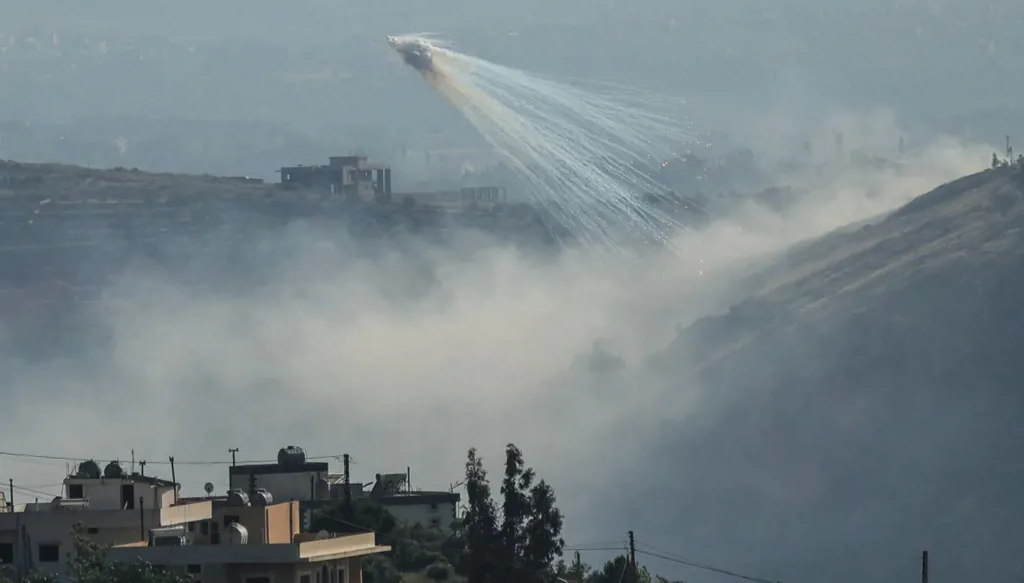
Image showing smoke rising during an Israeli bombardment of the outskirts of Yohmor village, southern Lebanon, on May 10, 2026. (AFP)
Can the war between Israel and "Hezbollah" in Lebanon stop without it stopping between Iran and the United States and Israel?
This is what the Lebanese authorities are aiming for by entering into direct negotiations with Israel under American auspices. Those who examine the five Lebanese demands will see that they are similar to those long stated by Sheikh Naim Qassem, Secretary-General of “Hezbollah."
The Lebanese authorities believe that if they succeed in securing these demands, which begin with liberating land and prisoners and extend to the return of displaced persons and reconstruction, they would weaken the justifications used by “Hezbollah,” which maintains its arms and military structure as the only path to renewed liberation, in light of diplomacy’s failure to achieve any tangible progress. In this case, it would become possible to implement cabinet decisions aimed at restricting arms exclusively to the state, especially with the beginning of arming the Lebanese army and other military and security institutions in the country.
In reality, the Lebanese authority is working to convince the White House to assist it in formulating an alternative project that gives direct negotiations their importance in Lebanon in general and among the Shiite community in particular.
But can Israel agree to the Lebanese roadmap?
Certainly not, as the most Israel can commit to at this current stage—and until a Lebanese plan is developed to disarm “Hezbollah” and dismantle its military structure—is to agree to revive a temporary ceasefire understanding, maintaining the situation as it is, provided that “Hezbollah” stops targeting Israeli forces within the “yellow zone,” refrains from enhancing its capabilities north of the yellow line, and with intensified monitoring of arms and funds smuggling.
The available information does not suggest that the White House will support the Lebanese demands, as it considers them a postponement of the “core issue,” namely disarming “Hezbollah,” to a secondary stage, reverting Lebanon to the state it was in before October 7th.
"Hezbollah" waits Iran
It seems unlikely that “Hezbollah” will adhere to any new ceasefire agreement resulting from the meetings scheduled in Washington on May 14 and 15, as it views the direct negotiations in Washington as a conspiracy against it aimed at weakening it. The party places its trust in the Islamic Republic of Iran, expecting it to set the rules for the cessation of hostilities, and remains on the front unless Iran issues a different directive.
Hezbollah benefits from the Lebanese authority’s reluctance to open an internal confrontation with it, as well as from the silence of its community, at least publicly, regarding the harm it suffers. This is reinforced by its significant capacity to endure human losses within its ranks, along with the Israeli army’s failure to find a means to fully contain fiber-optic drones that continue to inflict losses on Israeli forces stationed in the south and along the borders.
The latest Iranian response clearly exposed the American document, revealing a unified stance between Iran, Hezbollah, and other affiliated organizations. It calls for the cessation of hostilities to be simultaneous, such that what applies to the “arms” issue also applies to Iran itself.
Iran advances “the resistance front” organizations as a card of its strength in the confrontation with Israel and the United States.
Therefore, many believe that any new ceasefire agreement will not bear fruit, as the party will remain within the Iranian context on the one hand and will not concede to the Lebanese authority, allowing it to negotiate on its behalf or in matters concerning it.
Therefore, the most significant outcome expected from Washington’s meetings will be an Israeli promise, with American guarantees, of no regional ambitions in Lebanon and a commitment not to remain on its territory once it is confirmed free of “Hezbollah’s” arms, along with a readiness to resolve all outstanding issues between the two countries once permanent safety for settlements in the north is assured.
In doing so, the U.S. administration provides the Lebanese authority, through the direct negotiations it sponsors, with a “narrative of effectiveness,” linking tangible results to the disarmament of “Hezbollah.”
Disclaimer: The opinions expressed by the writers are their own and do not necessarily represent the views of Annahar.





 Messenger
 Whatsapp
 Threads
 Email
Email
 Print
Print
 X
X
 Facebook

