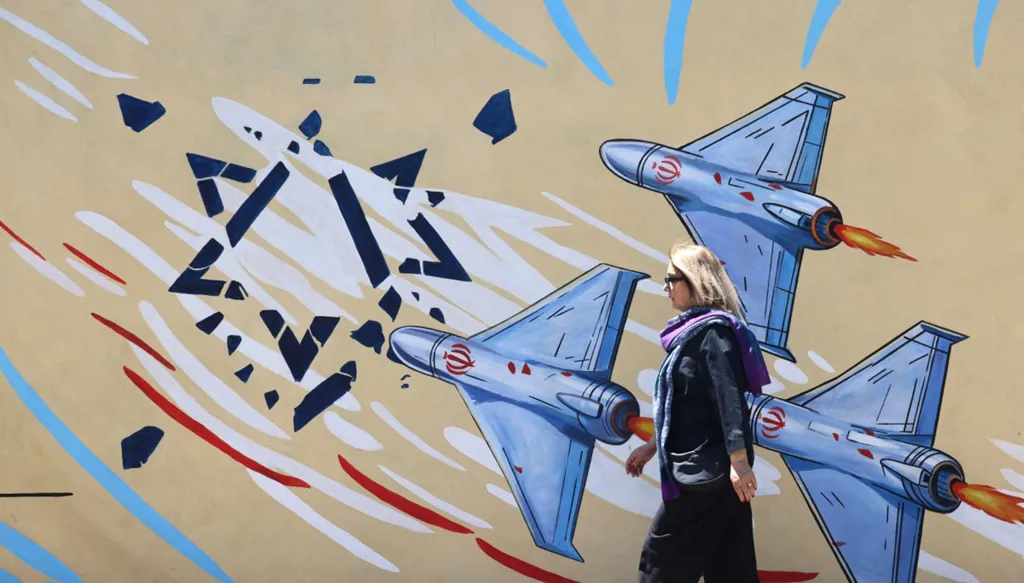
When reading the leaked information about the offer made by Iran to end the war, you might initially think it is a surrender offer to the other party, and that time will end the conflict as Tehran wishes, and we will hear this a lot.
In moments of major crises, the nature of countries' political thinking is revealed, not in their military stance, but in their way of interpreting reality. What’s noteworthy about Iran’s behavior is the tendency to offer "victors' deals" even in moments not supported by field facts. I’m talking about a pattern of thinking that defies logic, approaching what can be called "crooked thinking", as discussed in one of the "World of Knowledge" publications about the difference between straight and crooked thinking, in a book with that title published in August 1979.
Proper thinking, as defined by logic, is based on reading the facts and then building conclusions upon them. Crooked thinking stems from a preconceived belief and then searches for selected evidence to support it, or relies on a single element while ignoring more significant ones.
Serious consequences
In the Iranian case, some critics see this mechanism in its dealings with the world: funding armed groups while denying any connection to them, contributing to crises while maintaining claims of innocence. In this reading, the outcome is treated as predetermined, “we are victorious”, and subsequent events are then reframed to fit that conclusion.
This is not just an internal discourse aimed at presenting illusions to the public, but it has serious political implications. When a state insists on interpreting the outcomes of a conflict it has entered in a way that contradicts the observed results, it enters negotiations with one eye closed, losing the ability to make realistic concessions.
Moreover, it may raise its demands at a time when they should be lowered, thereby prolonging crises. It selectively chooses evidence that supports its view, then acts as if it has seen the whole picture. Some voices even claim that the United States has repeatedly called for an end to the war in stark terms.
Selective evidence
The book “Straight and Crooked Thinking” suggests that one of the most dangerous forms of crooked thinking is “selective evidence,” which means choosing what supports an idea while ignoring what refutes it. In some analyses of Iranian discourse, this is described as a focus on isolated fragments, while overlooking the broader costs to Iranian society in all its dimensions: a weakening economy, damaged infrastructure, and growing social pressures. In this view, such selective framing does not alter reality, but instead constructs a reassuring mental image within which the ruling elite operates.
This line of thinking is not confined internally; when translated into foreign policy, it can become a burden on regional stability, a “pain in the neck,” and may effectively amount to a refusal to recognize the balance of power. This can leave the other party with two options: either accept unrealistic conditions or continue confrontation. Often, the second option is more likely to prevail.
There is a psychological element that cannot be ignored. Systems that build their legitimacy on the idea of “perpetual victory” find it difficult to acknowledge defeat, because admission is not interpreted as a rational step but as a threat to internal legitimacy. As a result, concepts are redefined: withdrawal becomes “redeployment,” and loss is reframed as a “strategic victory.” This kind of conceptual reframing is presented here as a manifestation of crooked thinking.
Conversely, correct thinking does not mean weakness. In fact, it is a prerequisite for confronting reality and seeking solutions. Countries that clearly read their circumstances can reposition themselves intelligently. History is full of examples of states that have stepped back in order to advance further, because they had the courage to acknowledge reality before the courage to confront it. In this framing, the issue attributed to Iran is a lack of confrontation and accountability, a cultural and political phenomenon often associated with revolutionary states.
In the Gulf context, this difference becomes more significant. Dealing with a party that thinks outside traditional logic requires a dual approach: firmness in defending interests and realism in understanding the opponent’s behavior. It is not enough to respond to what is said; one must also read the motives behind it, while preparing for a broader public opinion battle.
Moreover, the international community must recognize that the issue is not only in policies themselves, but also in the way of thinking that produces those policies—that is, a political doctrine in which abandoning it can be perceived as a form of self-loss. Political or economic pressure may achieve limited results, but it must be accompanied by an understanding of the mindset shaping decisions. In this view, understanding Iran’s political mindset becomes important, particularly as it is described as relying on myth-making while simultaneously engaging in its deconstruction.
At what cost?
No country can negotiate indefinitely in a crisis situation while relying on assumptions about what might happen with the adversary and how it could change the course of events. Reality asserts itself sooner or later. The question is not whether this pattern of thinking in Iran will change, but when and at what cost. The longer the correction is delayed, the higher the cost; for the Iranian people, for its neighbors, and for the global economy.
Final word: when concepts are changed to hide the reality, reality doesn't change, but our ability to see it does.
Disclaimer: The opinions expressed by the writers are their own and do not necessarily represent the views of Annahar.





 Messenger
 Whatsapp
 Threads
 Email
Email
 Print
Print
 X
X
 Facebook