Mystery around Iran’s leadership deepens as absence of Supreme Leader sparks political and security questions
Reports and officials suggest growing uncertainty in Tehran as concerns rise over Mojtaba Khamenei’s condition, internal divisions, and Iran–US negotiations amid war tensions.
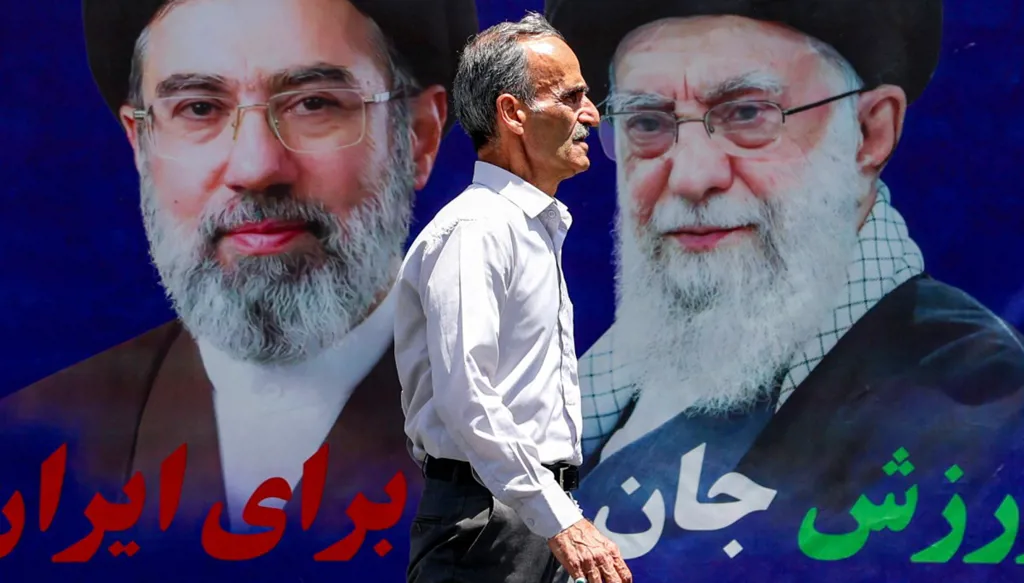
The Wall Street Journal reported on Sunday that the absence of Iran’s new Supreme Leader, Mojtaba Khamenei, from public appearances is raising concerns within Iran, as Tehran seeks to negotiate with the United States to end the war.
The newspaper cited American and Iranian officials as saying that “Khamenei was severely injured in an airstrike in February, which killed his wife, son, and his father, former Supreme Leader Ali Khamenei. Since then, Iranians have only received messages believed to have been written in his name and images that appeared to be altered or generated using artificial intelligence,” according to the American newspaper.
It added that “Khamenei’s absence has become an increasing problem for the Iranian regime, despite its leaders projecting unity during the war through coordinated political messaging and control over the armed forces, as divisions have begun to surface over the extent of concessions that should be made to reach an agreement with Washington.”
"Concern among hardliners"
According to historian and Yale University lecturer Arash Azizi, who reviewed conversations with staunch regime supporters, the prolonged absence of Khamenei has raised concerns among his hardline supporters, who have begun to question the legitimacy of the negotiations. They have also targeted more moderate politicians prominently involved in the talks, led by Mohammad Bagher Ghalibaf, accusing him of making major concessions in negotiations with the United States.
Tehran. (AFP)
Azizi told the newspaper, “They are questioning where he is,” adding that hardliners “are frustrated by what they see as numerous concessions from Ghalibaf and the team leading the National Security Council.”
Furthermore, the report noted that “some supporters of the hardline faction have posted messages on social media calling for Khamenei to at least issue a voice recording declaring his support for the talks.”
The newspaper pointed out that “the Supreme Leader has historically been the ultimate decision-maker on major issues related to Iranian national security,” noting that the founder of the Islamic Republic, Ruhollah Khomeini, made the decision to end the Iran-Iraq War despite describing the move at the time as “swallowing a chalice of poison,” while Ali Khamenei publicly agreed to the talks that led to the 2015 nuclear agreement.
No new images
The newspaper pointed out that “the Supreme Leader has historically been the ultimate decision-maker on major issues related to Iranian national security,” noting that the founder of the Islamic Republic, Ruhollah Khomeini, made the decision to end the Iran-Iraq War despite describing the move at the time as “swallowing a chalice of poison,” while Ali Khamenei publicly agreed to the talks that led to the 2015 nuclear agreement.
No new voice recordings have been released from him, although his father sometimes resorted to doing so when security risks were high, leading many Iranians to question whether he is still alive.
The newspaper cited Iranian officials as saying that Khamenei is staying out of sight to ensure his safety, particularly after Israel systematically targeted senior Iranian officials before the ceasefire, and that his name remains among Israel’s primary targets.
In the first public acknowledgment of a meeting with the new leader, Iranian President Masoud Pezeshkian announced that he held a two-and-a-half-hour meeting with Khamenei, a step the newspaper saw as aimed at dispelling doubts about whether he is still alive and managing the country’s affairs.
The newspaper quoted Iranian security affairs expert Saeed Gholkar as saying that Masoud Pezeshkian “is trying to convince both opponents and supporters that Mojtaba is hiding for security reasons, not because he passed away,” adding that this “is important because the Islamic Republic is working to conclude an agreement.”
Tehran. (AFP)
First-time details Late Friday, for the first time, an Iranian official disclosed details of Khamenei’s injuries, saying that his knee and back were injured in the raid that killed his father, while emphasizing that he is in good health.
Mazaher Hosseini, a senior official in the Supreme Leader’s office, said in a video released by the “Noor” agency linked to the Iranian Supreme National Security Council: “The enemy is trying, through various pretexts, to obtain an audio or video recording of him to misuse,” adding, “At the right time, he will speak to all of you himself.”
The newspaper considered that these statements did not dispel the impression that Khamenei is still unable to play an effective role in managing the country’s daily affairs, noting that Bashtiani’s statement focused more on the nature of the meeting than on its content, without specifying its time or place.





 Messenger
 Whatsapp
 Threads
 Email
Email
 Print
Print
 X
X
 Facebook