

From fragmented space to competing axes: Rethinking the geopolitical order of the Levant
A regional reading of shifting infrastructure, political fragmentation, and emerging economic corridors from the Strait of Hormuz to the Eastern Mediterranean and beyond



 Messenger
 Whatsapp
 Threads
 Email
Email
 Print
Print
 X
X
 Facebook


Ralph Daher
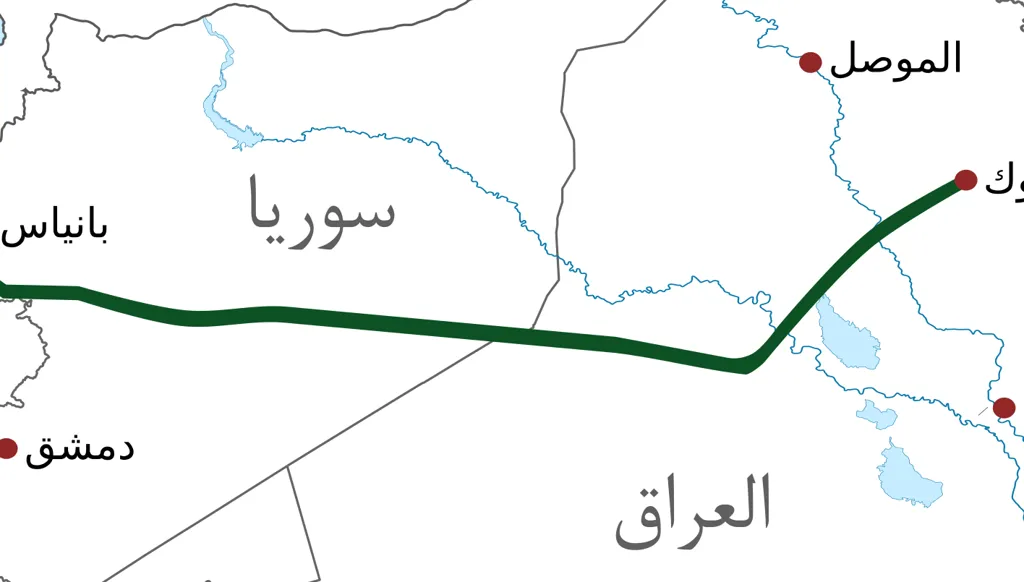
Annahar has published valuable studies on alternative routes from the Strait of Hormuz for oil exports, particularly Iraqi oil, most recently in its Friday, April 3 issue. In these studies, as in other Lebanese media outlets, the “Kirkuk–Baniyas” pipeline has been repeatedly mentioned. Hence, it seems useful, amid the growing use of this term, to recall some facts and use them as a basis for a realistic approach to regional transformations.
Wars are often reduced to their battles and immediate outcomes, but their reality is broader. They begin with the mobilization of resources at the expense of their normal uses, and during them the ability of states to endure depletion is tested. In this sense, every war is a loss and a reorganization of space, not merely a military confrontation. The sharing of resources and their redistribution take place through the reorganization of territory, including its people, mines, trade routes, and natural corridors. Space is not neutral, and possession or loss of resources creates balances of power between those who impose conditions and those who comply with them.
From oil pipelines to the reshaping of geography
In our region, the territory was radically reshaped after the First World War, when the French and the British divided the lands of the Ottoman Empire, particularly through control over routes and oil. The borders of Iraq, Transjordan, and Palestine were drawn in a way that allowed an oil pipeline to run from Kirkuk to Haifa, while the French obtained one quarter of the oil of Mosul, which enabled the creation of a branch toward Tripoli in exchange for relinquishing the province.
Oil reached Tripoli on July 14, 1934, and Haifa on October 14 of the same year. In 1940, the Tripoli refinery was established.
The declaration of the State of Israel led to the severing of the line to Haifa, making Tripoli the only outlet for Iraqi oil on the Mediterranean. However, this network did not remain fixed. In 1952, Syria created a branch of the Kirkuk–Tripoli pipeline toward Homs and Baniyas, bypassing Lebanon. The port of Tartus was built and connected to the Syrian interior, the Homs refinery was established in 1959, followed by the Baniyas refinery in 1981.
New Projects and Opposing Axes
Maps attributed to Benjamin Netanyahu since 2022 show a dangerous regional vision aimed at bypassing Lebanon. This vision seeks to circumvent what is referred to as the “Axis of the Curse,” which includes Iran and its regional allies across the Middle East, and to link Israel to economic networks extending through the Gulf and India, within what is known as the “Axis of Blessing,” represented as a logistical corridor from India through the Middle East and Israel, as part of a comprehensive reconfiguration of regional space.
In parallel, the space of Iraq, Syria, Lebanon, and Jordan is turning into a fragmented field between two axes: a southern axis shaped by Israel and a northern axis led by Turkey, while Egypt appears largely detached from this configuration. In contrast, Iran, Turkey, and the Gulf states possess geographical extensions that strengthen their positions.
Internal Transformations Deepening Fragmentation
The countries of the Fertile Crescent have undergone profound demographic changes, most notably population growth and migration to cities, without being matched by the construction of stable political legitimacy. Instead, they borrowed nationalist and religious slogans, and witnessed coups and internal conflicts fueled by external interventions, accompanied by policies of mutual isolation between states.
In this context, two key issues stand out. First, the similarity of social transformation trajectories across the countries of the region. Second, the increasing internal consolidation of societies within their borders, which makes traditional unity projects unviable.
Toward a Realistic Approach to the Region
On this basis, reality requires the search for new regional frameworks that treat the region as a functional unit by virtue of geography and shared challenges. This approach reduces the risks of marginalization, rebalances the distribution of influence between states, and opens the way for economic and functional integration based on specialization and economies of scale.
This does not imply redrawing borders but rather organizing the distribution of populations and activities and linking them to modern transport, energy, and communication networks, within a multi-centered system connecting the coast with the interior and the north with the south through major corridors.
Lebanon Between Marginalization and Repositioning
Lebanon has a direct interest in adopting this approach, given the risks of fragmentation and marginalization, and it also possesses, by virtue of its early experiences, a particular capacity to contribute to it. Tripoli stands out as a key starting point, not only because of its location but also because of its history of marginalization. Its reintegration into a broader regional network could transform it into an economic hub, provided that partial projects are replaced by a comprehensive vision.
The decisive factor remains political legitimacy. Experience has shown that reliance on external actors is an unstable formula, and that managing internal divisions increases costs. Effective legitimacy originates from within, from the state’s ability to secure individuals’ rights, within a gradual process that takes into account each country’s specificity.
Member of the “Citizens in a State” movement
Disclaimer: The opinions expressed by the writers are their own and do not necessarily represent the views of Annahar