

U.S. escalates pressure on Iraqi Prime Minister-Designate Ali Al-Zaidi over militias as Iran tensions shape his path to government
From political vetoes to economic leverage, Washington intensifies demands on Baghdad to curb Iran-linked armed groups while Iraq’s next government faces a tightening regional and financial squeeze.



 Messenger
 Whatsapp
 Threads
 Email
Email
 Print
Print
 X
X
 Facebook
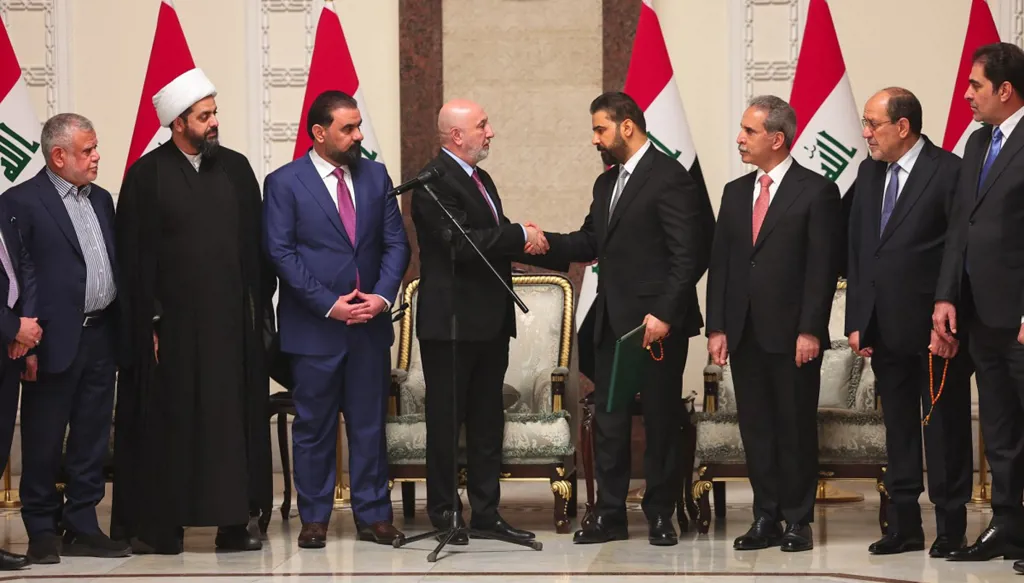


The United States has intensified its pressure on Iraqi Prime Minister-designate Ali Al-Zaidi to announce a formal separation between the government he is seeking to form and what it describes as “terrorist militias,” according to statements by a U.S. official to CNN, who outlined the main demands of the administration of President Donald Trump toward Baghdad.
While Al-Zaidi is facing internal complications linked to the distribution of sovereign positions among major political forces, which spent months in disputes and disagreements before being nominated by the “Coordination Framework,” a coalition bringing together the main Shiite forces except for the Sadrist movement, external pressures are also significantly shaping developments.
One of the most prominent issues in this context is Trump’s veto on the return of former Iraqi Prime Minister Nouri Al-Maliki to power (2006–2014). This has further strained relations among Shiite factions, particularly between Al-Maliki, outgoing Prime Minister Mohammed Shia Al-Sudani, and their respective allies.
What does Washington want from Al-Zaidi amid the Iran conflict?
Al-Zaidi’s appointment comes amid regional and international tensions that directly affect Iraq, following the war launched by the United States and Israel against Iran, and the subsequent involvement of Iran-aligned factions in Iraq through missile attacks on American interests in the country.
A senior U.S. State Department official, speaking anonymously to CNN, said that “resuming full support first requires expelling terrorist militias from all state institutions, cutting off their funding from the Iraqi budget, and preventing the payment of salaries to their fighters.” He noted that U.S. facilities in Iraq were subjected to more than 600 attacks after the outbreak of the war on February 28, before attacks stopped following a declared truce.
The official also urged Al-Zaidi to clarify the “unclear boundary” between the Iraqi state and Iran-aligned armed groups.
U.S. expert to Annahar: no place for independent militias
Kenneth Katzman, an American expert at the Congressional Research Service, told Annahar that “what Trump wants is very clear. He insists that the Popular Mobilization Forces factions loyal or aligned with Iran be completely dismantled or disarmed. As with Kataib Hezbollah, these groups may operate as political parties, participate in politics, and run in elections, but without weapons, missiles, or artillery.”
He added: “Any armed group in Iraq must be fully under the control of the central government’s security institutions. There is no place for independent militias, nor for militias linked to Iran or any other external actor.”
After his appointment, Al-Zaidi reportedly received a call from Trump, who wished him success in forming “a new government free of terrorism and capable of achieving a brighter future for Iraq,” according to Trump’s post on his Truth Social platform. Al-Zaidi later stated on X that Trump invited him to visit Washington after forming his government.
Katzman expects Trump to insist that Al-Zaidi distance armed militias from his government. He noted that similar demands were made of Al-Sudani, who expressed support for such an approach but did not implement it in practice. Therefore, Trump is expected to strongly insist that Al-Zaidi carry out these policies.
However, Iraqi sources recently told Annahar that some armed factions not formally part of the Popular Mobilization Forces, which are officially under the Iraqi state, are seeking to hand over their weapons to the PMF as a step toward integrating into the next government.
Crowley to Annahar: Weakening militias in Iraq is one of the goals of the Iran war
Former U.S. State Department spokesperson P. J. Crowley links the Iran war to Donald Trump’s policy in Iraq in an interview with Annahar. He says: “I currently look at Iraq from the perspective that there are unresolved issues regarding Iran. One of the objectives of the Trump administration’s intervention against Iran was to weaken the regional arms affiliated with Tehran, and a number of these groups are active inside Iraq.” He adds: “The U.S. president will be expecting the government of Ali Al-Zaidi to work on reducing the militias’ ability to threaten American forces and interests in the region.”
Iraqi officials and observers criticize Washington for “failing to appreciate” the risks of any potential confrontation between Iraqi authorities and armed factions. Some Shiite political forces viewed Trump’s veto on Al-Maliki as a form of “American guardianship” over Iraqi political decision-making, while opponents of the leader of the State of Law Coalition saw his mere nomination as a provocation to them and to the Arab environment and the United States, and as support for Iranian influence in Iraq.
On U.S. pressure regarding armed factions, Katzman says: “It is clear that this could cause unrest among some supporters of the Popular Mobilization Forces aligned with Iran and among their leaders. Many of them are now sitting in parliament and have become well-known politicians, but they will have to accept this reality. Otherwise, cooperation with the United States will be very difficult.”
Will economic pressure threaten the salaries of millions of Iraqis?
Alongside political pressure, there are increasing economic pressures that are burdening Al-Zaidi even before he begins his duties, especially amid losses caused by the closure of the Strait of Hormuz on Iraq’s oil sector, which makes up most of the country’s budget and threatens a major decline that could affect the salaries of millions of public employees.
In addition, Washington has suspended cash payments from oil revenues, which were previously handled by the Federal Reserve Bank of New York under an agreement dating back to the U.S. invasion of Iraq in 2003.
Katzman also believes that “the United States will continue to pressure Iraq, particularly regarding the U.S. dollar, financial transfers, and the banking sector. Trump will continue to pressure the Iraqi government and restrict its access to dollars if it fails to prevent funds and transfers from reaching Iranian or Iran-aligned entities.” In his view, all of these points are “completely non-negotiable.”
Al-Zaidi now has 18 days left to present his government cabinet within the 30-day constitutional deadline after he was tasked with forming a government by the new Iraqi president Nizar Amidi on April 27.