

Entire families wiped out in Hay el Sellom massacre
In Beirut’s densely packed Hay el Sellom, April 8 airstrikes left dozens dead, destroyed entire families, and turned tightly built homes into fields of rubble, as survivors recount moments of terror, loss, and failed rescue efforts amid overwhelming devastation.




 Messenger
 Whatsapp
 Threads
 Email
Email
 Print
Print
 X
X
 Facebook
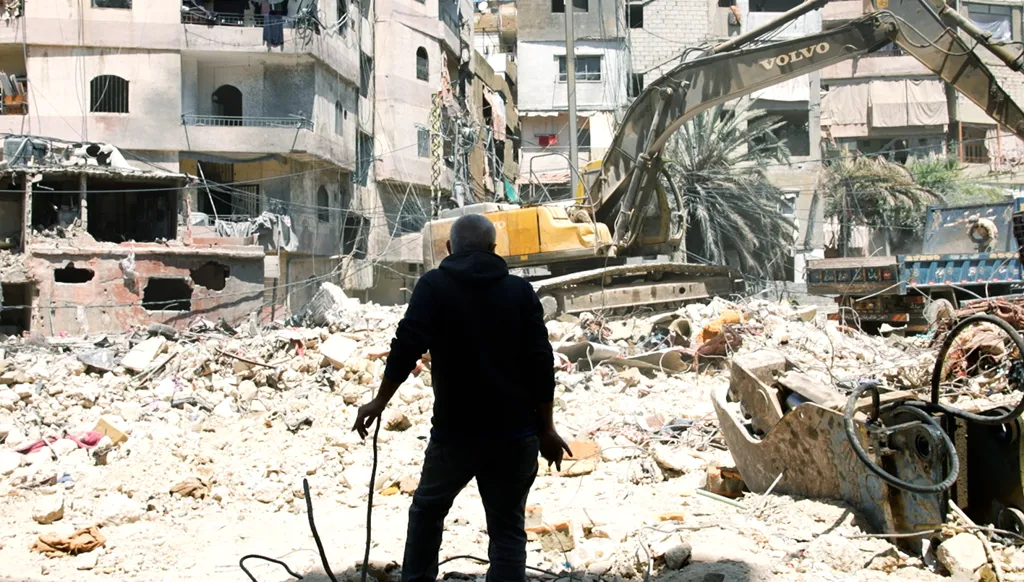


On the outskirts of the Ghadir River in the Hay el Sellom neighborhood, a bulldozer has been operating since April 8, extracting bodies alongside rubble from a building that once stood in its humble form among deteriorating structures, before being brought down in a single moment by three Israeli missiles.
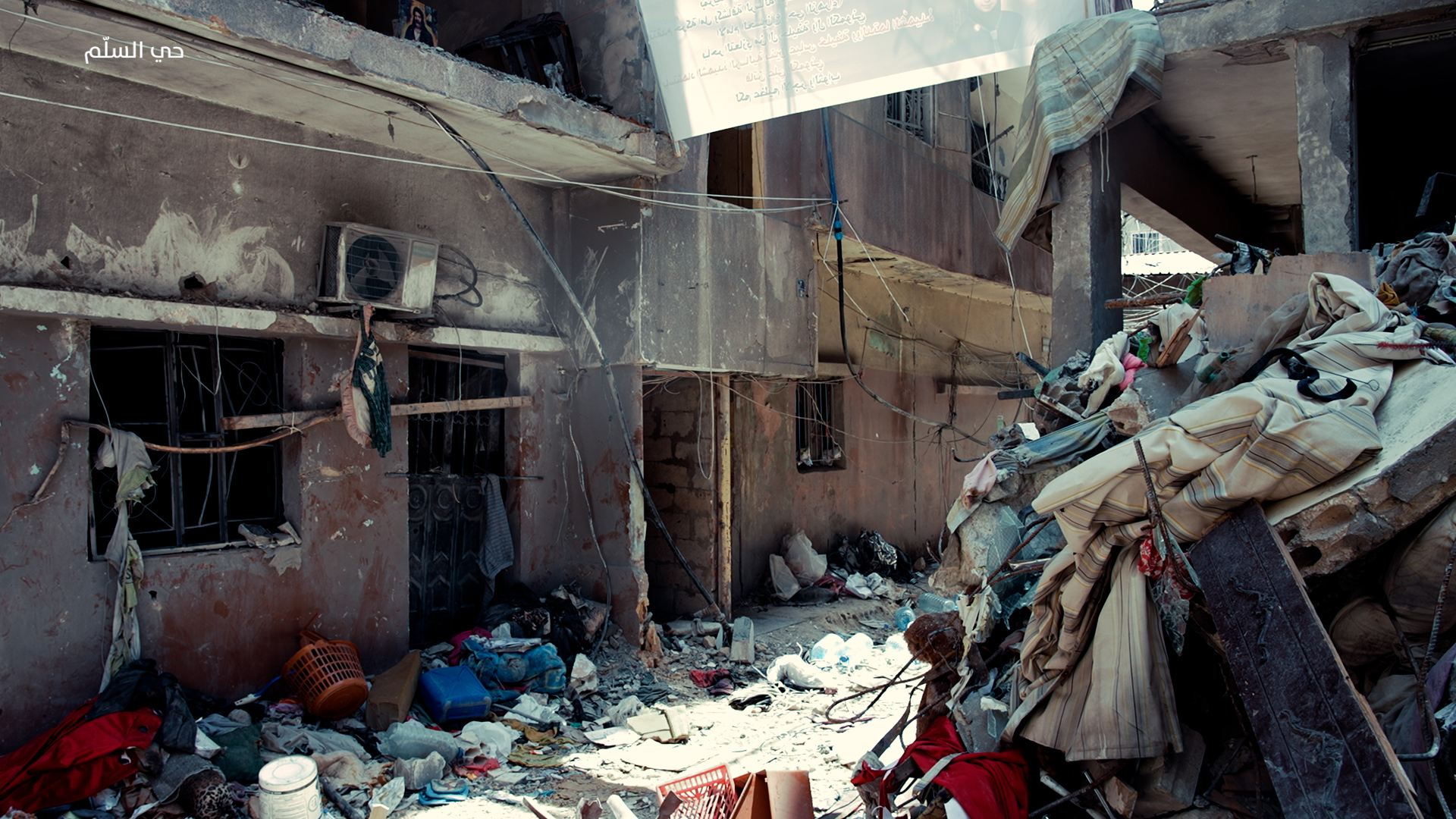
In this neighborhood, where buildings are tightly packed as if they form one body, the density reflects an exposed face of poverty without any embellishment. On the ruins, harsh stories surface, just as some bodies were carried into the river by the force of the explosion or in an attempt to escape it.
Three missiles were enough to bring down three buildings, each consisting of four floors, meaning twelve floors collapsed all at once. Residents describe the sound of the missile as a snoring noise, a sound that marked a decisive moment between life and death.
Here, between the walls of homes, at the doorstep of Ali Ahmad’s shop, and in the square where children used to play, the massacre took place.
That strike was the first in the neighborhood, before the air raids expanded to four other neighborhoods in the area, completing the chapters of the tragedy. On that day, around ninety-nine victims fell, in addition to a large number of wounded, in one of the most deadly and brutal strikes.
In the Zahra district near Al-Nahr Bridge, the stories of twenty-three people came to an end, including four children. There, among the rubble, dreams remained suspended and laughter was suddenly extinguished.
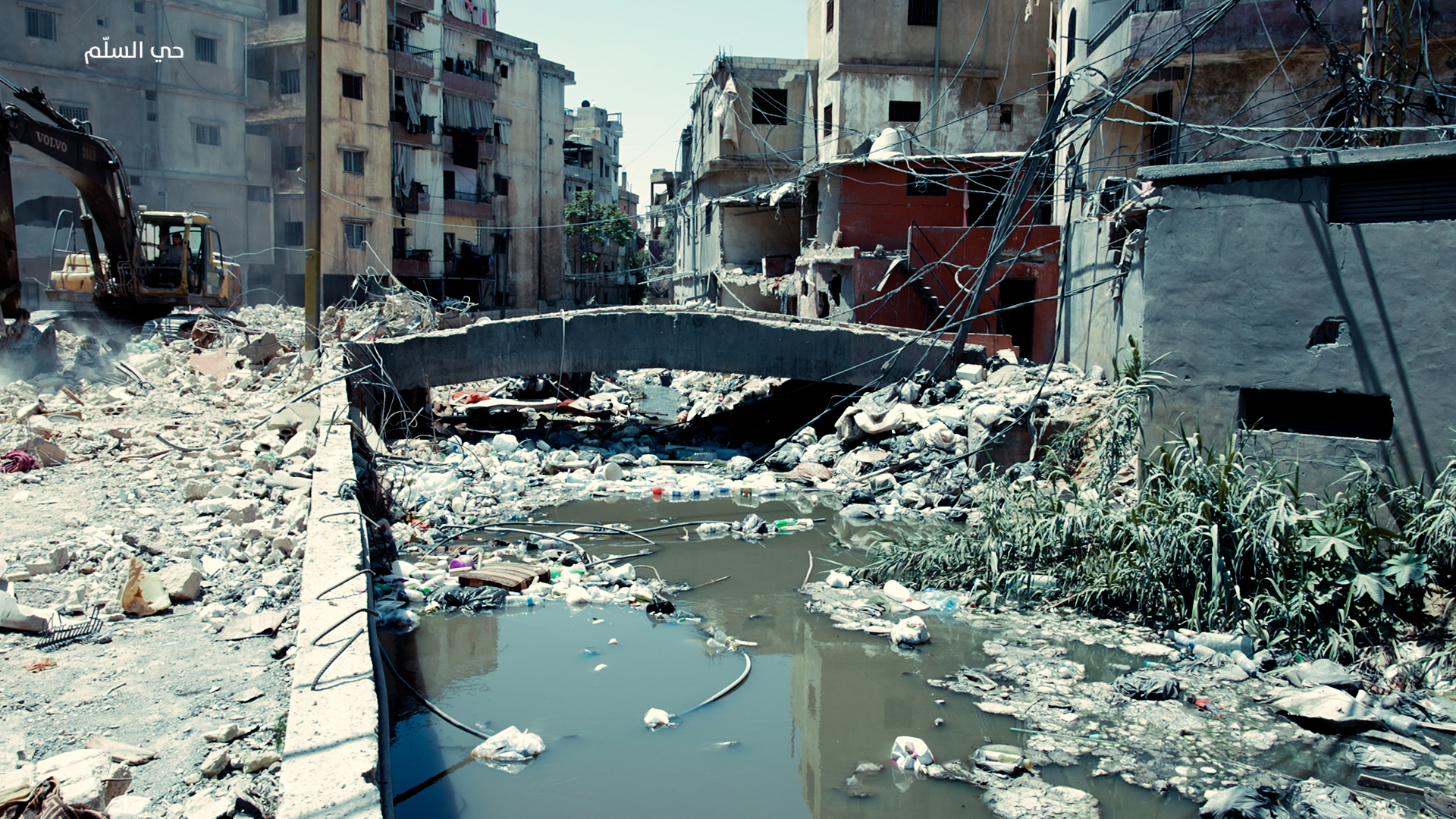
In those tightly packed houses that almost merge into one another, where urban planning is visibly absent and the smell of the river remains a constant witness to the harshness of life in this area, bulldozers continue their work removing what remains of the rubble.
Alongside them, trucks move in an unending flow, going back and forth, unloading their cargo of stones and memory, of destruction that, until April 8, had been a complete, living life here.
An area the size of a city, with a population matching it, collapsed all at once onto its residents and those displaced to it.
A place that many had considered a safe refuge, previously untouched by threats, turned within minutes into a field of rubble.
Collapse of already fragile buildings
Six strikes hit different sites across Hay el Sellom district, but the reality was the same: densely packed, already fragile buildings collapsed as if they had never been there.
Doaa Shams, a survivor of the massacre, says: “We used to say that the blast wave alone was enough to bring these buildings down because of their cracks and how tightly they were attached to each other… so what happens when there are three direct missiles? It is a real tragedy.”
The tragedy was not only in the moment of the bombing, but also in what followed. Major challenges faced rescue operations, but the reality, as residents describe it, was even harsher.
They say neglect was the most prominent feature of a devastated area, where rescue teams arrived late in the evening, leaving residents to face the rubble with their own hands and endure their pain and losses alone.
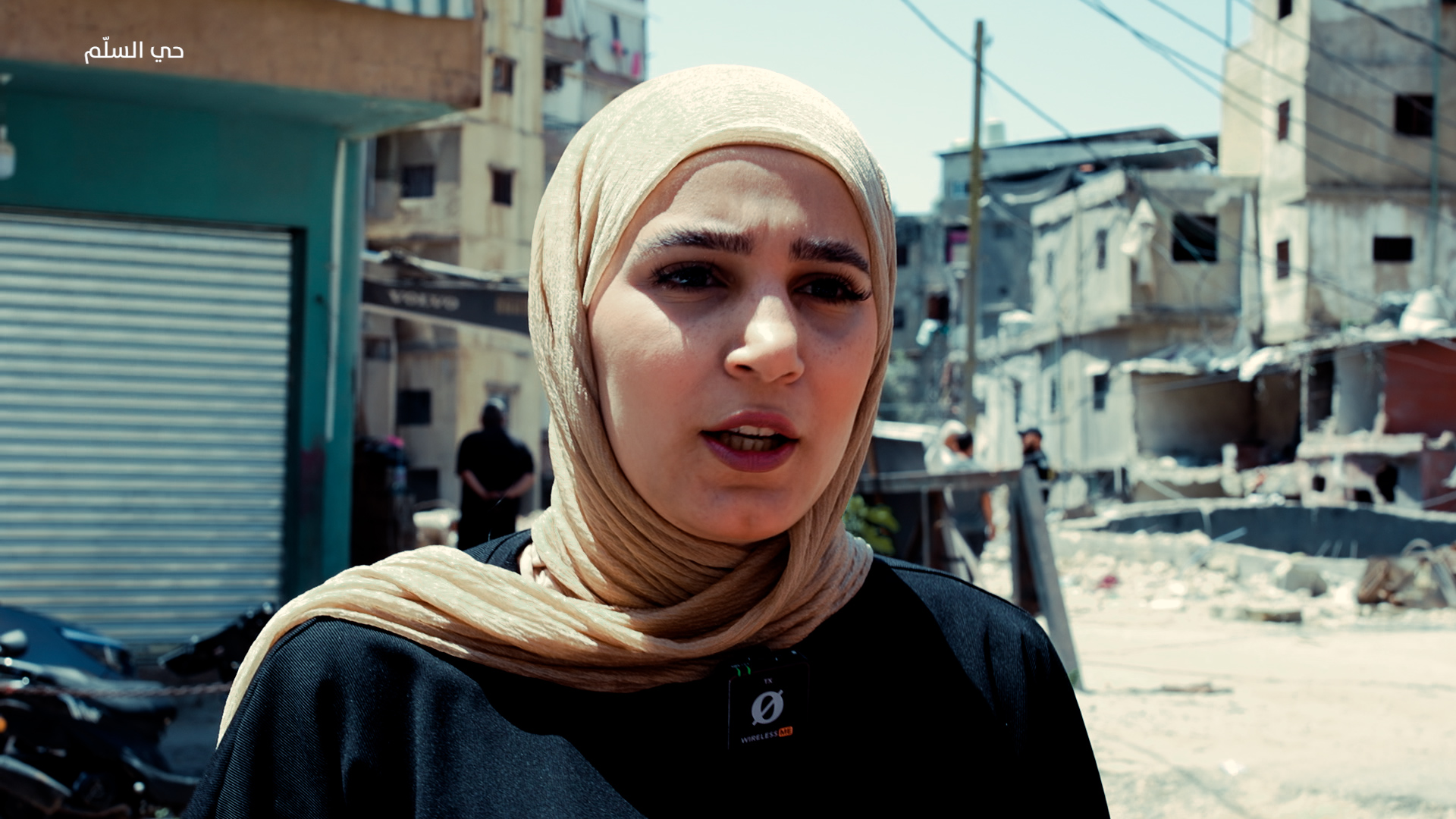
Doaa also recounts how her brother, despite being injured, did not step back. “He started with a group of young men from the neighborhood working with their bare hands to lift the rubble and rescue those trapped in the targeted buildings,” she says. She adds, “Their hands were the bulldozers… they were the excavator that did not arrive until the evening.”
During those heavy hours, there were only individual attempts and a will to survive fighting amid absence, where people preceded machinery in confronting the rubble.
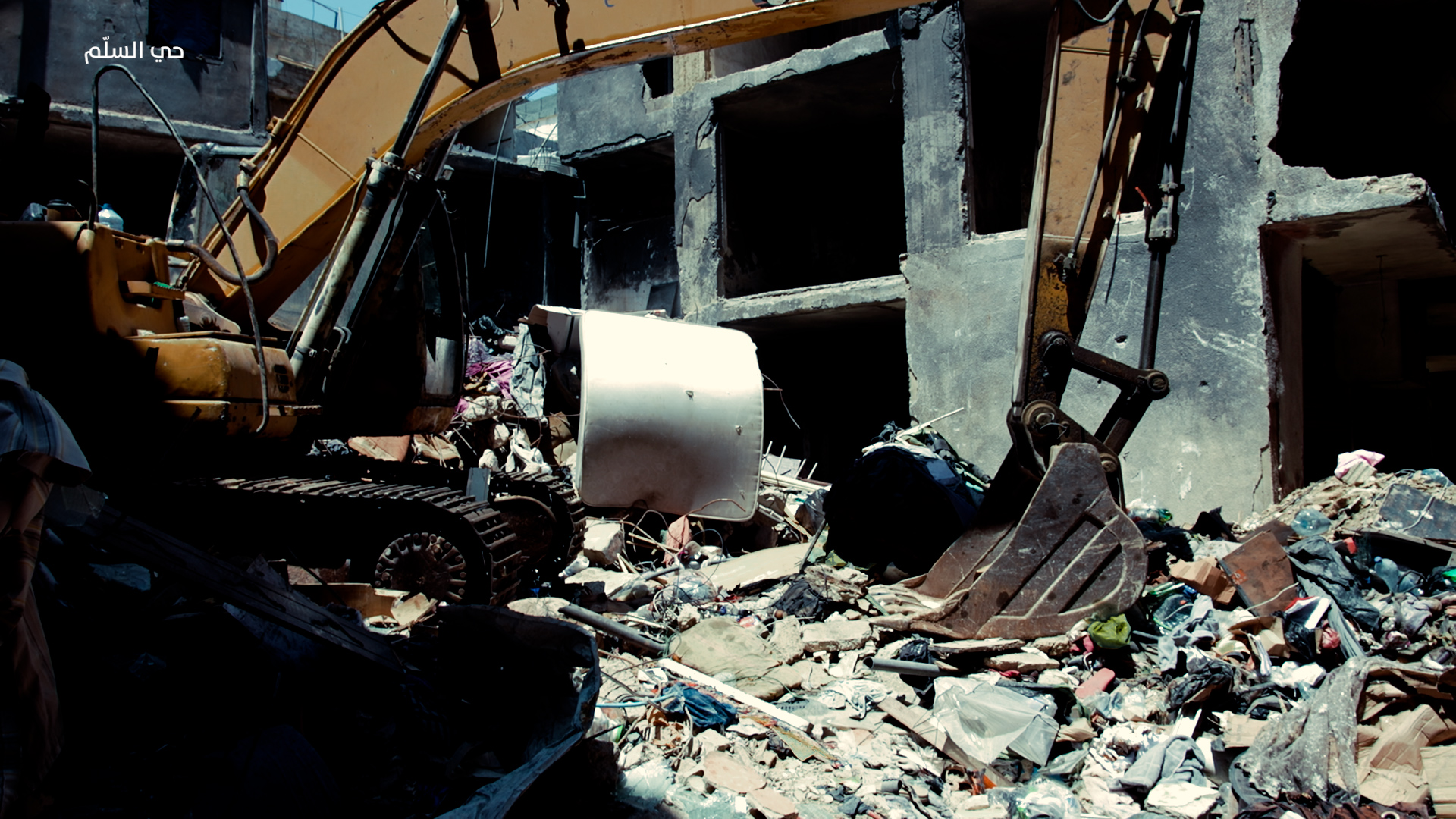
The narrowness of the alleyways and the density of the buildings prevented heavy machinery from reaching some sites, as in the Sawan building, where a small excavator remained amid the ruins of the targeted structure.
It was a scene that seemed almost unreal, a harsh image summarizing the reality of the place, where limited resources stand helpless in the face of the scale of destruction.
History of the Hay el Sellom District
The district emerged on agricultural lands once known as “Al-Bayarat,” where groves of citrus, olive, and prickly pear trees had spread before the area gradually began attracting waves of displaced people searching for housing near the capital.
In the 1950s, the first families arrived there, while the population grew significantly in the 1970s amid social and economic changes that drove many toward internal migration from the outskirts, particularly from the south and the Bekaa.
With this influx, the features of transformation began to take shape: agricultural lands were fenced off, and simple rooms were hastily built, forming the nucleus of a residential fabric that quickly expanded beyond any organized urban planning.
Over time, the orchards turned into narrow streets, often carrying the names of the families who settled in them, turning the neighborhood into a densely packed residential cluster.
In the 1970s, this transformation accelerated, and the neighborhood took on an informal urban character, administratively known as the Sadr Village, although its reality on the ground reflected unregulated growth, part of which expanded over state land.
With the absence of infrastructure and basic services, signs of poverty and fragility became deeply rooted, becoming a defining feature of this overcrowded neighborhood, born from the transformation of farmland into a forgotten city on the margins of the capital.
Today, this area carries poverty, blood, and remains that left behind painful stories, irreplaceable orphanhood, and a river that stands as a witness to the residues of life and the bodies of some of the victims.
“We could no longer see anything”
Mohamad Karneib, a member of the civil defense, explains that the narrow alleys of the Hay el Sellom district posed a major obstacle to rescue operations. He says, “In one of the strikes, we even considered demolishing a small house to allow the bulldozer to reach the targeted site and recover bodies from beneath the rubble, before we eventually managed to secure a smaller bulldozer capable of accessing the area.”
Duaa’s house stood only about 100 meters from the strike site, yet what residents describe as “God’s mercy” prevented a larger disaster, as the blast wave was directed toward the river.
The residents heard nothing but the “snoring sound” of the missile before the three buildings collapsed over the heads of women, children, and civilians in a moment that left no chance of survival.
Duaa recalls the moment of the explosion as if it is still trapped in her memory: “We could no longer see anything… black smoke, suffocation, and the feeling that death was near, before we could even understand what had happened.”
A few minutes were enough to completely overturn the scene. People were in their homes, in ordinary moments, before everything ended all at once.
On the ground, first, second, and ground floors, no one survived. The force of the blast was lethal. As for those on the upper floors, some were able to survive, while others threw themselves into the river, escaping the blast or driven by its force.
For a moment, everyone thought the missile had fallen directly over their heads. That was exactly what Duaa experienced. She was in the kitchen, about to head to the balcony to understand the source of the sound, when the missile exploded right in front of her.
She recalls: “Everything around me was white… I couldn’t see anymore, I was suffocating from the smoke, and the sounds of women and crying filled the place… a feeling that cannot be described.”
Families wiped out entirely
Neither Duaa nor the other survivors of the Hay el Sellom neighborhood massacre expected to come out alive from the attack. No clear narrative ever identified the target of the April 8 massacres, yet residents agree that the Israeli claims do not reflect what happened on the ground. The truth, as they describe it, is that buildings collapsed onto civilians, and most of the victims were women and children.
Residents confirm that many displaced families had taken refuge in the area, staying with relatives or acquaintances, which doubled the scale of the tragedy. In the Al Rihani family alone, seven people were killed. Ali Ahmad, known among locals as Ali al Zain, the owner of a shop in the neighborhood, was also killed along with his son Jawad, the scout boy whose photos once circulated during the Pope’s visit to Lebanon. His wife and daughters survived because they were not at home at the moment of the strike.
Other victims came from the Al Ashqar, Al Zain, and Fayyad families. A woman recalls the story of the only son from the Fayyad family, whose mother kept waiting near the rubble, holding on to the hope that he might still be alive.
Many stories remain buried under the rubble, known only to their families and the neighborhood residents, stories that have not yet reached the light.
4 Hours Under the Rubble
Amid this grim death, a window of hope emerged with the rescue of 13 people alive from beneath the ruins. Fatima Taqi is one of those who survived after spending nearly four hours under the rubble, holding her two-year-old daughter in her arms. Of the building she lived in, only four people survived: Fatima, her child, and two others.
She recounts to Annahar the hardest moments of her life, when she confronted death with all her strength, saying, “I had no choice… I would not leave that place without my daughter.”
She could hear her son outside calling, “Mom, if you are still alive, answer me.” She clearly remembers the sound of the missile before it struck and exploded, describing those moments as “a nightmare.”
Like many families, Fatima was unable to leave her Hay el Sellom district home due to tough economic conditions. She, like others, was relying on receiving a warning that would allow evacuation, but no warning came.
On April 8, Israel launched raids on various areas across Lebanon without prior warning, with the Hay el Sellom neighborhood receiving the largest share of the attacks. The building collapsed, and with it Fatima’s hopes, leaving her only her arms trying to protect her young daughter amid the rubble.
Fatima remained for more than an hour calling for help, searching for survivors amid the destruction, repeating her cries: “People, help me… is anyone alive?” She screamed into a silence answered only by rubble, before her son arrived searching for her and his sister.
Young men from the neighborhood began removing the rubble and widening the opening where she was trapped. The child was rescued first, then Fatima was pulled out from under the debris, granted life again but with heavy physical and psychological injuries, including three pelvic fractures.
"My children... my children"
Speaking with residents of the Hay el Sellom district was not easy. Many refused to talk, while children, surprisingly, recounted details that should never have remained in their memories.
One child, no older than eight, told me, “There were bodies and body parts… I saw one with my own eyes.” A heavy question imposes itself: how can a child’s memory carry such brutality when it should be holding only lessons, games, and the memories of childhood?
Yet in this poor district, life seems to follow a different path, unlike any other life.
Narrow alleys make it difficult for cars to pass in some areas, which explains the heavy reliance on motorcycles or walking. There, scenes were too harsh to easily recount: disfigured or burned bodies, widespread panic, and one voice rising above all others, the voice of death.
Rescuer Mohammad Korneib recalls a scene he cannot forget: a father shouting “My children… my children,” banging his head against the wall in grief, while his children were still under the rubble. Three children died together, returning from school before their daily journey turned into a final moment when a seven story building collapsed on its residents.
Near the site of the first strike, Korneib describes another even more painful scene, where a father lost his wife and all his children. He says in a heavy voice, “Entire families were wiped out.”
“We can’t leave here”
From street to street, the reality of the area becomes even more severe. In the ruins of the Sawan building, which is about 70 years old, traces of the tragedy are still visible on surrounding buildings, as well as children’s toys and women’s belongings that remain as witnesses to what existed before the decisive moment.
This five story building collapsed in seconds after being hit by two missiles. The explosion left behind only heavy destruction and black smoke that covered the area, spreading into nearby buildings like a living witness to the intensity of the strike.
Nearby, resident Mehdi Haidar tries to repair what he can inside his damaged home. He works in silence, making small repairs while trying to contain the destruction, saying with painful realism, “We can’t leave here… my children’s work is here, I can’t leave them.”
He remembers the black smoke that covered the area before residents realized the location of the strike. No one expected the Sawan building to collapse entirely, killing eight people in a single moment.
The Israeli account claims the targeted building housed Ali Dehini and that his body was recovered three days after the massacre. Residents, however, insist these claims are false, stressing that those under the rubble were innocent women, children, and civilians killed in a direct and unjustified strike, as they describe it.
Mehdi cannot erase the sound or the thick smoke that filled the neighborhood. He says, “The strike was powerful.” He adds that no one expected Hay al Sellom to be targeted this way, or for buildings to be struck and collapse entirely in one blow, a scene he describes as unprecedented in the area.
Despite everything, Mehdi did not leave his neighborhood. He remains in what he describes as a densely populated area where people live closely together, side by side, as if holding on to what remains of life there.
He left for a week after the strike, unable to endure what had happened, before returning again to his home and the life he knew in Hay al Sellom.
Above the ruins of the building, where a small excavator still stands in silence, a sign bears the images of the victims Benin Abbas Khalifa and her daughter Faten Ali Al Kamouni.
We continue forward while destruction accompanies every step. The field scene is harsh in its details, and the stories still trapped there reflect the scale of the massacre that struck this area.
We arrive at the Al-Umara neighborhood, also known as “The Five Wings,” were completely leveled, leaving behind the tragic end of 32 victims in a scene that summarizes the brutality of what happened.
There, no one wanted to speak, they gathered their wounds and sorrow and moved on.
Many stories remain buried under the rubble, with one phrase lingering on their lips: May God have mercy on everyone.