Iran’s narrative trap: How revolutionary identity became a strategic constraint

Opinion 08-05-2026 | 11:04

Iran’s narrative trap: How revolutionary identity became a strategic constraint

Once a source of revolutionary strength, Iran’s ideological narrative now risks becoming a self-imposed constraint, limiting flexibility, deepening crises, and raising the question of whether a state can outgrow the story it was built to tell.

Iran’s narrative trap: How revolutionary identity became a strategic constraint
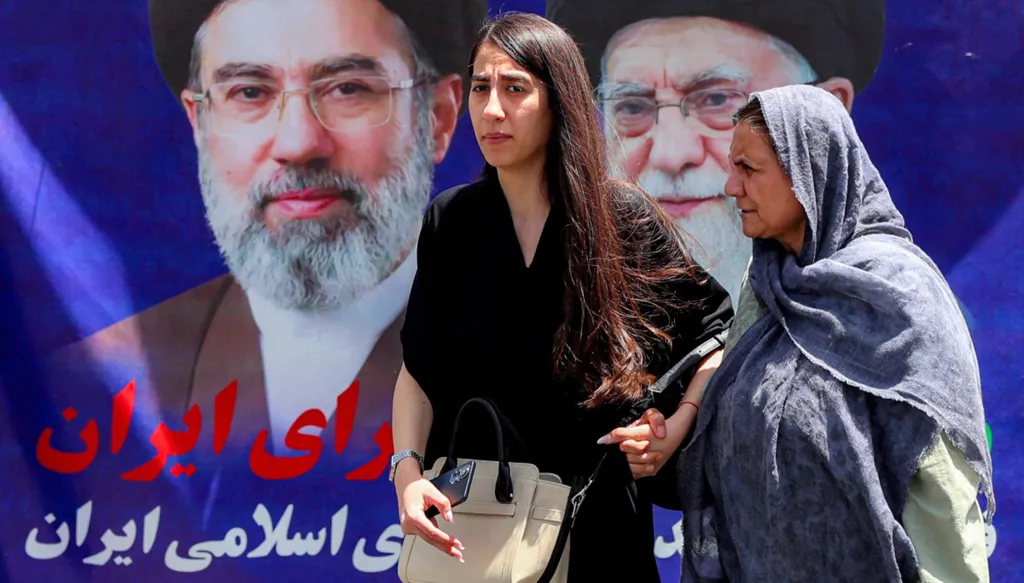
A large banner featuring the current Supreme Leader of Iran Ayatollah Mojtaba Khamenei and the late Supreme Leader Ali Khamenei in a Tehran street on May 6, 2026. (AFP)
Smaller Bigger


In a world where military power or economic wealth alone are no longer enough to guarantee international standing, a new concept has emerged that shapes the balance of influence: the possession of narrative power.


Purely material achievements are no longer enough; controlling meaning has become the most important and influential factor. Possessing narrative power means having the ability to shape how achievements are perceived and to impose a framework of thought even on adversaries.


The central idea is not to present a flawless narrative of oneself, but rather a narrative that incorporates negative elements and skillfully uses context, making all those elements serve the ultimate goal of the national narrative.


But what happens when the narrative shifts from a tool of power to a constraint that binds its owner? This is the central question posed by the situation in Iran today.


The religious-ideological dimension plays a pivotal role in the “rigidity” of the narrative upon which the Iranian regime is based, as it provides it with a symbolic depth that surpasses traditional political calculations.


The regime does not present itself merely as a nation-state, but as a bearer of a religious message and apostolic mission derived from the Iranian Islamic Revolution, making it more tied to the idea of a “project” than to the idea of “power.”


But this very strength carries a paradox: the more the narrative relies on the ideological dimension, the less flexible it becomes in the face of real-world changes.


When the narrative becomes a prison


Since the 1979 Revolution, the Iranian regime has built its legitimacy on a specific narrative foundation: resistance to “global arrogance” represented by the United States, hostility toward Israel as an occupying entity, exporting the Islamic revolution worldwide, and defending the oppressed.


This narrative is not merely transient political rhetoric but has become the very basis of the regime’s existence and identity. Khomeini is the founding father of this narrative, which has become personally and revolutionarily linked to him.


However, over time, this narrative ceased to be just a tool for mobilization and unifying ranks but became a guiding framework directing all of the state’s decisions and policies. The years following the revolution have shown that adherence to this narrative creates significant contradictions that are difficult to resolve.


Striking contradictions


Economically, Iran possesses large resources but desperately needs to open up to the world and attract foreign investment to revive its economy under suffocating sanctions.


However, a narrative of absolute enmity toward America and the West makes any real openness appear as a retreat from principles and a betrayal of the revolution. The result is an ailing economy and a population that pays the price.


In the nuclear file, Iran can make concessions to lift sanctions and improve its situation. However, the narrative of “Iran’s absolute right to enrichment,” “resisting Western pressures,” and acquiring a nuclear weapon to fortify the narrative and the project without explicitly stating so limits the negotiation space and makes any concession seem like surrender.


The regime finds itself compelled to maintain the image of the “resistant state,” even when national interests require more pragmatic policies.


Foreign proxies


In foreign policy, Iran is doctrinally obliged to support its regional allies: “Hezbollah” in Lebanon, the Houthis in Yemen, resistance factions in Iraq, and the Syrian regime in the past.


This support drains the country’s resources and increases the regime’s international isolation.


Yet, retracting from it is immediately read as a retreat from the principles of the revolution and an unforgivable weakness.


When narrative trumps interest


This is precisely what it means for a state to be “hostage to its narrative”: the regime cannot easily abandon its narrative, as its collapse would mean the fall of its own legitimacy.


On the other hand, continuing to adhere to it deepens economic and political crises, making any real reform almost impossible without “breaking the narrative mold” that has trapped it.


Thus, the Iranian regime revolves in a vicious circle: a rigid narrative prevents adaptation, lack of adaptation deepens the crisis, and the crisis reinforces adherence to the narrative.


This condition becomes more complicated amid the leadership crisis the regime faces, especially following the assassination of first- and second-tier leaders, including former leader Ali Khamenei, making it difficult for new leaders to offer concessions central to the regime since 1979.


The price is paid by the people


One cannot discuss this dilemma without touching on the Iranian people who pay the highest price. While the regime uses the narrative to maintain its power, citizens suffer from escalating inflation, chronic unemployment, suffocating social constraints, and the threat of renewed war at any moment.


Many Iranians, especially the youth and middle class in urban areas, feel they are more hostages to this narrative than the regime itself.


Iran is a nation governed more by narrative than by interest. What began as a tool for unifying ranks and mobilizing the masses at the start of the revolution has now become a restraint limiting the state’s ability to adapt to a rapidly changing world.


Disclaimer: The opinions expressed by the writers are their own and do not necessarily represent the views of Annahar.