

Saudi diplomatic efforts and Lebanon’s fragile security landscape



 Messenger
 Whatsapp
 Threads
 Email
Email
 Print
Print
 X
X
 Facebook


The current political and security situation in Lebanon is highly complex. Israeli attacks continue, having targeted medics, journalists, and civilians, as well as destroyed homes. At the same time, Hezbollah has resumed military operations in the south.
This makes the ceasefire more fragile and calls for diplomatic efforts to establish a permanent cessation of hostilities. This is intended to pave the way for security arrangements that would lead to the withdrawal of Israeli forces from occupied Lebanese territory and the return of displaced people.
These steps are meant to prepare for two key phases: reconstruction and the extension of Lebanese army sovereignty over all Lebanese territory, along with restricting weapons exclusively to state institutions.
Saudi diplomatic efforts
In order to build a security framework that prevents the collapse of the state and supports internal understandings among its institutions, Saudi diplomatic efforts have aimed to create a favorable regional environment that gradually moves Lebanon out of the axis conflicts.
The goal is for Lebanon not to become a bargaining chip used by Iran in its dialogue with the United States, nor a arena where Israel imposes a de facto reality through force.
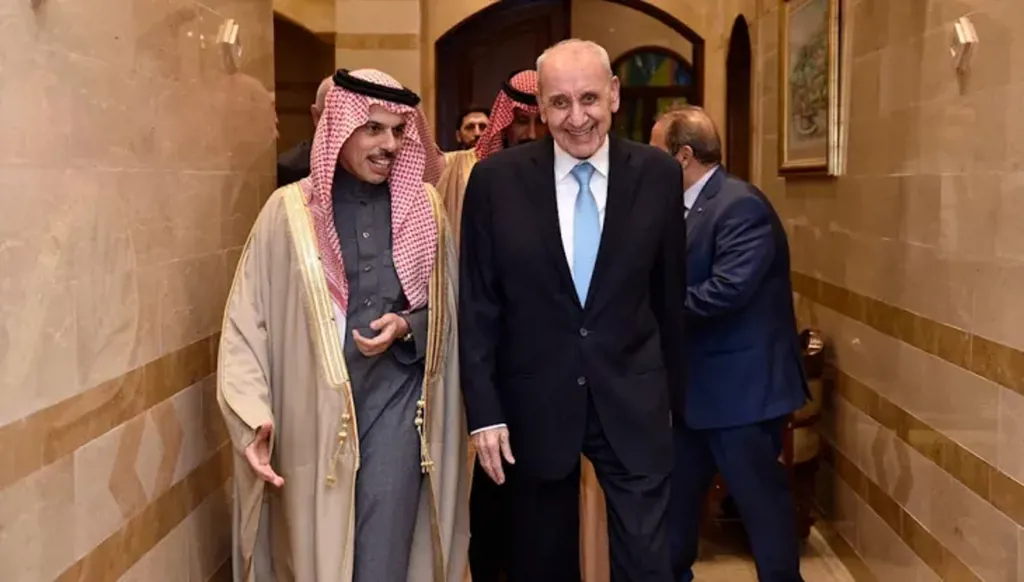
Saudi Foreign Minister Prince Faisal bin Farhan held a phone call on April 23 with Lebanese Parliament Speaker Nabih Berri. They discussed developments in Lebanon and ongoing efforts to achieve a complete halt to Israeli attacks, while reaffirming the Kingdom’s support for the stability of the Lebanese Republic and the strengthening of its state institutions.
A statement from the Saudi Foreign Ministry noted that Nabih Berri praised the Kingdom’s role and its continued efforts in supporting Lebanon and preserving its security and that of the region. He also affirmed Lebanon’s commitment to the Taif Agreement and its rejection of anything that threatens Saudi Arabia or undermines its security.
These remarks from Berri are significant. In addition to being Speaker of Parliament, he is currently the most influential political figure in relation to Hezbollah and is able to address its audience in a language it understands without being accused by the party of betrayal.
This makes his position extremely important in the coming phase, as it could help drive real changes that ease sectarian tensions, facilitate the process of restricting weapons to the state, and reassure displaced people regarding reconstruction and their return to their villages and towns in the south.
Also, when Nabih Berri affirms his rejection of anything that threatens Saudi Arabia or undermines its security, he positions himself within a clear Arab stance that aligns with security and stability. This distances him from a previous revolutionary and inflammatory rhetoric that at times led to isolation from the Arab environment.
Berri now considers that period a political mistake that must be corrected, and that it is time to strengthen good relations with the Kingdom of Saudi Arabia through state institutions, without aligning with cross border axes at the expense of Lebanon’s national interest and its people.
At the heart of this movement, there was also a visit to Beirut by Prince Yazid bin Farhan, adviser to the Foreign Minister for Lebanese affairs. He met with the three presidents and parliamentary figures in an effort to bring positions closer together and build bridges between them, in order to create internal understandings that make the Lebanese position more coherent and unified, and to limit any street tensions caused by uncontrolled groups.
Reclaiming state sovereignty
The political framework of this diplomatic movement was clearly reflected in the Saudi Foreign Ministry statement issued on April 16, which welcomed the announcement of a ceasefire between Israel and Hezbollah. It reaffirmed the Kingdom’s support for the Lebanese state in asserting sovereignty and restricting weapons to the state and its legitimate institutions, while praising reform steps and efforts to preserve Lebanon’s resources and the safety and unity of its territory.
Saudi priorities are interconnected and complement each other, leading toward a stage of stability and development. They include a permanent ceasefire, the withdrawal of occupation forces from Lebanese territory, the extension of state authority over all territory and the restriction of weapons to legitimate institutions, followed by the return of displaced persons, the launch of reconstruction, and the reform of state institutions.
Disclaimer: The opinions expressed by the writers are their own and do not necessarily represent the views of Annahar.