

The United States as the dominant global pole
Power consolidation through military, economic, technological, and soft power supremacy amid shifting geopolitical realities.



 Messenger
 Whatsapp
 Threads
 Email
Email
 Print
Print
 X
X
 Facebook


After the narrative that the United States was declining as the dominant pole or even collapsing, and that other poles were rising, and the claim that Israel was heading toward collapse, described as “weaker than a spider’s web,” another narrative emerged to compensate for the weakness and emptiness of those earlier claims.
This new narrative argued that the United States and Israel had failed to achieve their objectives in the costly and destructive wars they launched in the region since late 2023.
In this way, we saw that this wishful narrative remained a repeated refrain voiced by parties within the so-called “resistance and deterrence” alliance over the past two years, despite the enormous and alarming transformations in political, security, and economic maps internationally and regionally, including in the Middle East.
War and the transformations of the world
For instance, for example, most of the militia actors within the so called “resistance and rejectionist” axis have almost disappeared in Syria, Lebanon, Iraq, and Yemen.
Israel, through its brutality, has managed to turn the Gaza Strip into an area unfit for normal life for two million Palestinians. The Assad regime has completely collapsed in Syria.
As for Iran, after attempts to distance itself from wars over two decades, relying mainly on its militia proxies, it has now become directly concerned with defending its borders, its regime, and its existence as a normal state.
More importantly, there are two significant developments that must be understood in order to properly deal with their consequences, meaning to overcome the risks arising from them.
The first is that Israel, which destroyed the Gaza Strip, has come to dominate the Palestinians, their people, geography, and resources, between the river and the sea, more than at any previous stage.
The second is that Israel continues to deepen its control in the West Bank by expanding settlement activity, turning settlers into a military militia, and consolidating its violations in Jerusalem. This also includes further fragmenting the emerging Palestinian entity as envisioned under the Oslo Accords, weakening the position of the Palestinian Authority by restricting its role and depriving it of its clearing funds.
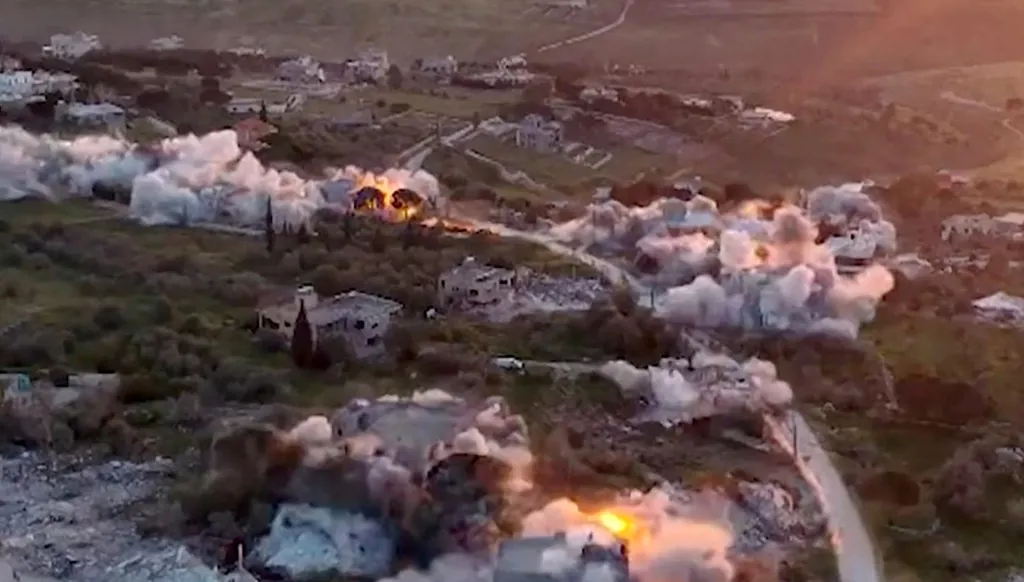
Israel also continues its attacks on Lebanon after having eliminated most of Hezbollah’s capabilities and leadership, while it threatens Syria through its military and political interventions. In both Syria and Lebanon, it is working to impose buffer zones within the geography of the two countries under the pretext of protecting its “national security,” a concept that goes beyond geography to demographics, reflected in attempts to exploit social fractures along ethnic and sectarian lines in both Syria and Lebanon
Sources of Israel’s power
In sum, Israel, described as aggressive and unconstrained, has become something like a major regional power, or a decisive state in shaping the political, security, and economic architecture of the Middle East more than at any previous stage in its history, even more than during the 1967 war, to the point that its long arm now reaches Yemen and especially Iran itself.
Of course, beyond Israel’s military, economic, and technological strength, it also relies on three main sources of power. The first is its political stability, as despite the internal contradictions embedded within it between religious and secular groups, Eastern and Western communities, right and left wings, and moderates and extremists, it remains a state governed by elections within a democratic system for its Jewish citizens, with separation and independence of the three branches of government.
The second is its monopoly over nuclear weapons in the region, which is why it is keen to prevent any Middle Eastern state from acquiring nuclear capability. The third is Western support for it, particularly the United States’ guarantee of its security and superiority in all respects across the region.
The United States as the dominant pole
Regarding the United States, it has established itself as the controlling pole of political, military, and economic developments in the world, not only in its confrontation with Iran, but also in relation to other powers, especially China and Russia.
For example, the BRICS grouping showed no real movement throughout the war period, even though the Iranian system and even Putin’s Russia had been relying on this bloc to displace the United States from the throne of the international order.
The strength of the United States does not come solely from its possession of the world’s highest military capability, as it accounts for nearly 50 percent of global military spending, amounting to around 900 billion dollars. Its power also derives from four main sources.
First, its economic strength, which has a major impact on most developed countries.
Second, its role as the primary source of technological and scientific advancement in the world across various fields.
Third, its soft power, meaning its ability to impose its model through peaceful means via media, universities, and entertainment industries.
Fourth, its relatively limited exposure to the direct consequences of war compared to other actors, particularly due to its geographical distance and its dominant position in the global system.
Nevertheless, despite all these facts, there are still those who live in a state of denial, detached from reality for ideological, emotional, or fatalistic reasons. If everything that has happened suggests that the United States and Israel have not achieved their objectives simply because a leader of a state or faction still exists and refuses to acknowledge what has occurred, while his life and his state are no longer functioning normally, then what would the situation be if those objectives had actually been achieved?
It is well known that what has taken place, namely the destruction of urban areas and infrastructure, is far more severe and impactful than the removal of a leadership that still believes it is more important than its own country and people.
This narrative is also used to justify the continuation of the war by the United States and Israel on the grounds that their objectives have not yet been achieved.
Disclaimer: The opinions expressed by the writers are their own and do not necessarily represent the views of Annahar.