

Between brink and bargain: The war of perceptions
As Tehran tests the limits of escalation and Washington reshapes the narrative, both sides trade signals, proposals, and interpretations in a fluid standoff where collapse, compromise, and calculation blur into one another.



 Messenger
 Whatsapp
 Threads
 Email
Email
 Print
Print
 X
X
 Facebook


Iran expressed tension in its conduct. It refused to send a negotiating delegation to Islamabad, then sent Foreign Minister Abbas Araghchi again to the Pakistani capital carrying what was said to be a response to American proposals. Its media outlets promoted dissatisfaction with Pakistan’s mediation and described it as biased toward the United States. It hinted at a preference for the Sultanate of Oman’s mediation and directed Araghchi toward Muscat and Moscow.
Reports said that US President Donald Trump and the National Security team in his administration are studying new Iranian proposals. White House spokesperson Karoline Leavitt had informed us that her president had thrown a previous Iranian list of conditions into the trash, which raised questions about whether the new Iranian proposals would meet the same fate.
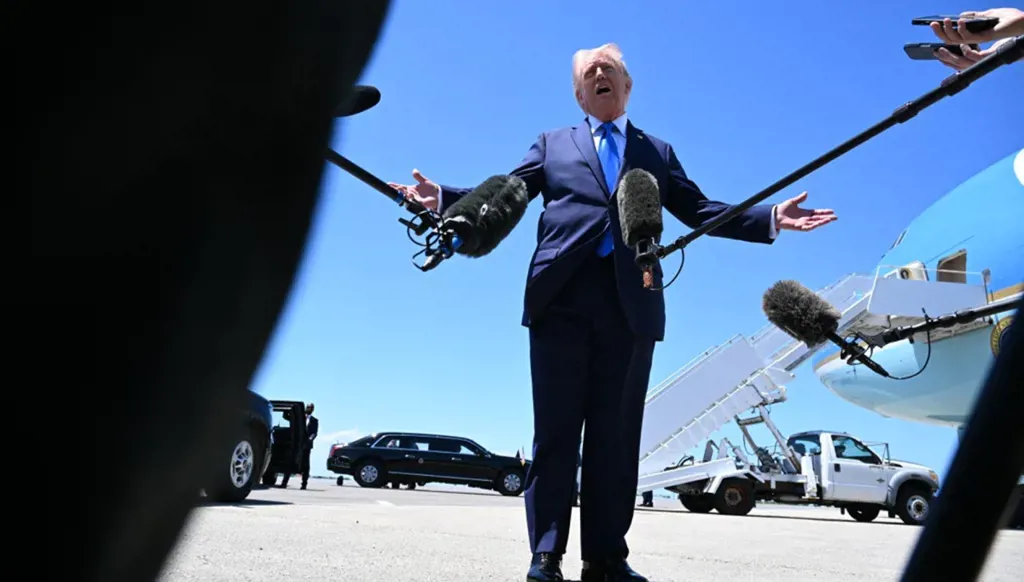
Trump expressed frustration and dissatisfaction after reviewing Tehran’s proposals. The Iranian document contained all the elements of provocation that, in theory, the US president should have rejected without even troubling himself or his team to study it, yet he did not. He did not become angry when the Iranian delegation refused to come to Islamabad, and he merely advised his envoys, Jared Kushner and Steve Witkoff, not to endure an 18-hour journey, since Iran was not ready to offer anything new. He told Iran: “Call us whenever you want.” And when he was asked whether Iran had violated the truce by directing two ships toward its shores, he denied it.
A moment of “wisdom” descended upon the President of the United States, leading him to present matters from the perspective of a wise philosopher, or perhaps a cunning strategist who knows something others do not.
Shifting war objectives
Trump’s declared objectives at the beginning of the war have shifted, some of them serving the propaganda of the moment. He had hinted that the war aimed at the survival of the regime itself, Iran’s nuclear and missile files, and dismantling the network of regional proxy forces. But in recent days, he has not budged even slightly from a single goal: “Iran will not possess a nuclear bomb.”
This shift has worried Israel. Yet Israel, which is committed according to Prime Minister Benjamin Netanyahu’s words to Trump’s decision regarding the war on Iran, is relying on Tehran to create a deadlock that would justify resuming the war again.
Iran has publicly rejected zero enrichment of uranium and the transfer of highly enriched stockpiles outside the country, meaning it has refused to hand its nuclear program to Trump as a gift. Nevertheless, Trump has limited himself to considering the hardship of an 18-hour journey for his envoys as a reason to suspend negotiations and not resume fighting.
In light of the US president’s “reflections” and his “wisdom,” Araghchi returns to the Pakistanis with a surreal and unusual proposal. He jumps with the Iranian document to the very last line: an end to the war and the lifting of the blockade on Iran’s ports, in exchange for opening the Strait of Hormuz, followed later by the resumption of negotiations that had stopped in Geneva.
In other words, Iran is bypassing the 38-day war that allegedly dismantled its capabilities, leadership, and forces, and is sending the US president a bargain based on a “you give something up and I give something up in return” logic. Trump, his administration, and American media then study the matter.
Unpredictability as a method
Trump draws the conclusion he prefers and turns it into a marketable narrative. He says: “Iran has informed us that it is on the brink of collapse and is requesting the opening of the Strait of Hormuz.” The listener reflects on this version without risking speculation about what lies behind it. The man in the White House is unpredictable, and he wants what he presents as a victory that could be described as a reversal in his approach, shifting from one extreme decision to its opposite.
But Trump does not speak arbitrarily, and he must have heard from Muscat about the atmosphere of Araghchi’s meeting with Sultan Haitham bin Tariq, and he also heard about the Iranian minister’s meeting with Russian President Vladimir Putin in Saint Petersburg.
Iran has long boasted of its ability to play on the edge of the abyss. Trump now claims, based on his own information, that Iran has reached the brink of collapse. The implication behind his words is: “I see ripe heads ready for the harvest,” suggesting he may move sooner than expected, ushering in a moment of “reaping” before the world even realizes that the outcome he seeks, as the occupant of the White House, may already be within reach.
Disclaimer: The opinions expressed by the writers are their own and do not necessarily represent the views of Annahar.