

A fifth presidential term for Congo's Nguesso: Stability or stagnation?
As one of Africa’s longest serving leaders extends his rule, the Republic of the Congo faces a deeper question about the cost of continuity in a changing society.



 Messenger
 Whatsapp
 Threads
 Email
Email
 Print
Print
 X
X
 Facebook
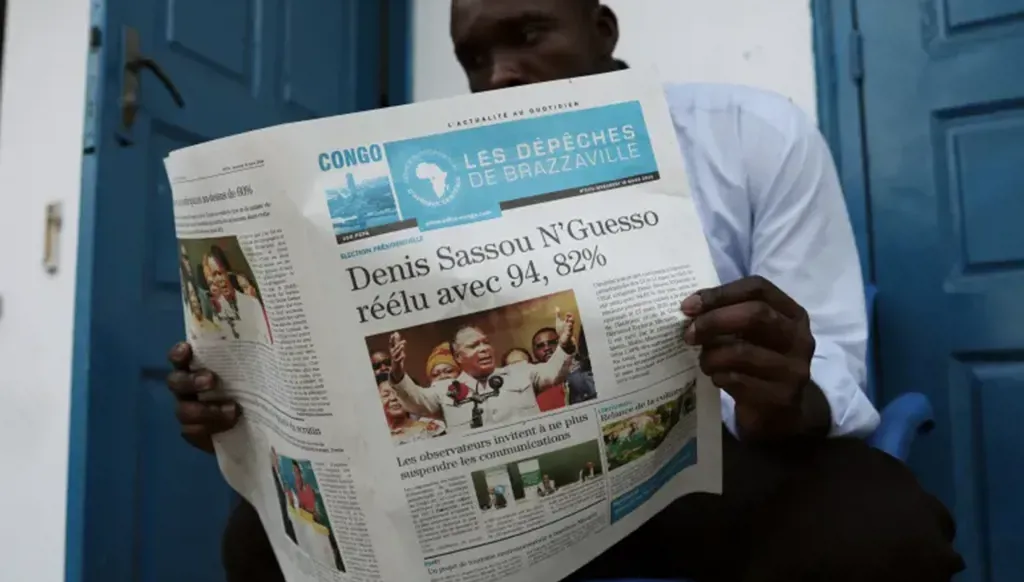


On April 17 of this year, Denis Sassou Nguesso was inaugurated as president of the Republic of the Congo for a fifth term.
Nguesso secured about 94.8 percent of the vote in the March 15 election, which saw turnout of around 84 percent. He ran against six opposition candidates, but none were major contenders, making it difficult for them to form a viable political alternative.
Who is Sassou Nguesso?
Sassou Nguesso is not an ordinary president. He is one of Africa’s long serving leaders. A military officer who evolved into one of the continent’s shrewdest political figures, he first took power between 1979 and 1992, before returning to office in 1997 after a devastating civil war that nearly destroyed the country.
Nguesso has now spent a total of 42 years in power, ranking third in Africa in terms of longevity in office. Teodoro Obiang Nguema, president of Equatorial Guinea, holds the top spot with 45 years, making him the longest serving leader in the world today. He is followed by Cameroon’s president Paul Biya, who has been in power for 44 years. In fourth place is Uganda’s president Yoweri Museveni, who has now entered his fourth decade at the helm.
While Sassou Nguesso has combined long experience with political adaptability and an ability to manage power dynamics, like many leaders who have remained in office for decades, he has faced persistent criticism over the limited democratic transfer of power, particularly after amending the constitution in 2005 to remove term and age limits, allowing him to run again. There have also been criticisms related to restrictions on political and media freedoms.
A familiar pattern in Africa
Against this backdrop, Africa today finds itself facing a clear paradox. While some countries are moving toward the transfer of power, others have opted for the long term continuity of their leaders.
With the exception of Senegal, this continuity remains a familiar pattern in Francophone West Africa, as well as in a few East African countries such as Uganda, Rwanda, Eritrea, and Djibouti.
In his fifth term, Sassou Nguesso, now 83, faces several domestic challenges, including a severe economic crisis, financial fragility, rising public debt, and the country’s heavy dependence on oil. Youth unemployment is also on the rise.
“Sassou Nguesso V” is also facing calls for political reforms. In his recent inauguration speech, he pledged to focus on economic development and job creation. However, achieving these goals will depend on his ability to implement deep structural reforms.
Despite these internal challenges and criticism over his grip on one man rule, there is a belief that he has succeeded in maintaining the continuity of state institutions in his country, which lies within a regional environment that has been marked by a high degree of instability over the past decades.
Drawing on his accumulated experience in power and his extensive diplomatic network, Nguesso is seen as a figure who has played behind the scenes roles in mediation and advisory efforts.
A number of African leaders continue to turn to him to benefit from his long experience in dealing with complex conflicts, particularly in major crises such as the Libyan crisis and the civil war in the Central African Republic.
This role has likely reinforced his image as a political “wise man” capable of reading regional shifts with calm and pragmatism.
Stability, but at what cost?
Some may argue that stability in the Republic of the Congo justifies Sassou Nguesso’s continued rule, and that a country like his needs strong leadership capable of navigating a fragile environment.
Yet this logic, which appears realistic on the surface, conceals a deeper dilemma. Stability that does not renew itself gradually turns into stagnation, and power that does not change loses its appeal and its ability to adapt to a society that is itself evolving.
The paradox remains that a long stay in power can become a burden. Each new electoral term raises public expectations and narrows the room for excuses. Over time, the question is no longer how long this system can endure, but at what cost.
Disclaimer: The opinions expressed by the writers are their own and do not necessarily represent the views of Annahar.