

2026 Palestinian municipal elections: Service governance or a quiet political reconfiguration?
Low turnout, contested power dynamics, and shifting priorities in West Bank and Gaza local elections raise questions about governance, representation, and the future of Palestinian political life.



 Messenger
 Whatsapp
 Threads
 Email
Email
 Print
Print
 X
X
 Facebook
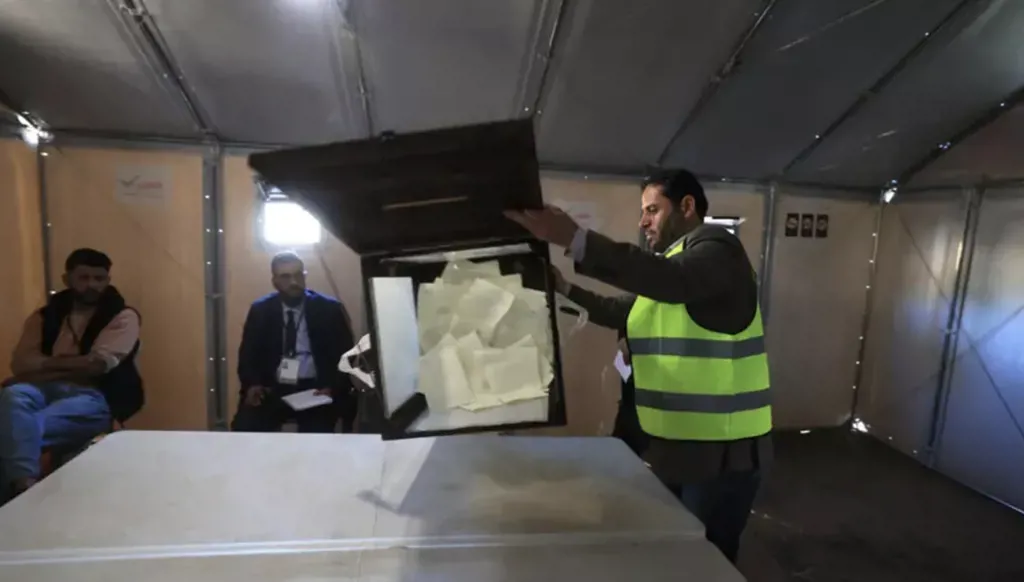


The significance of the local elections held in the West Bank and the Gaza Strip city of Deir el-Balah last Saturday cannot be understated, as it was a long-overdue entitlement needed for Palestinian towns and villages to provide some essential services.
However, another dimension—or perhaps the unannounced objectives—of this process—has raised many questions, which may be politically and strategically more important, and may lie behind it an unclear future project.
The process took place amid a fierce Israeli assault on the Palestinian Authority areas. Some Israeli occupation figures revealed their malicious intentions to re-annex the West Bank, with Israeli Energy Minister Eli Cohen stating, "What is happening in the West Bank is the application of Israeli sovereignty on the ground," despite U.S. President Donald Trump's rejection of the annexation decision and European countries' opposition to this aggressive action.
The electoral process led to the renewal of management councils in 380 municipal and village units, of which 197 councils were uncontested, while 183 councils were elected in competition among businessmen, family, and tribal figures.
The majority of the new councils are aligned with the political wing that controls the authority in Ramallah, without any role for the “Hamas” movement, which does not mean that the “Fatah” movement completely dominated the scene, as the list it supported lost in the city of Jenin, one of the most prominent administrative units with significant political symbolism.
A set of observations and conclusions can be noted in the context of evaluating the electoral process:
First: Why were the municipal elections held before the presidential and legislative elections, which have been stalled since 2005 and 2006, respectively? And why did the elections not include East Jerusalem? Even if the occupation forces would disrupt them, including an invitation to the Jerusalem area and its environs has national and political symbolism.
If we link these questions with the results of the municipal elections, which led to a majority of businesspeople and pragmatists, we might develop an idea of intentions to marginalize the national and political dimension in favor of self-management services for the West Bank and the Gaza Strip, distancing the militant stance.
The future may even lead to renouncing the demand for an independent Palestinian state with East Jerusalem as its capital, according to the Arab Peace Initiative of 2002, in favor of a project similar to “peace councils” or economic zones being established in the Gaza Strip and other regions and countries.
Second: The participation rate in the local elections held on April 25, 2026, which amounted to about 54%, reflects a politically significant indicator, especially when compared to previous rounds that ranged between 60% and 64%.
This decline, although numerically limited, clearly expresses a decline in electoral enthusiasm and a decrease in the level of political mobilization, reflecting a cautious popular mood leaning towards some withdrawal.
It also indicates a gradual erosion of confidence in the usefulness of the electoral process, not only as a service tool but as a gateway to any broader political change, in a general environment characterized by political stagnation and ongoing pressure from occupation forces that constrain national action and limit its prospects.
Third: The results clearly entrenched the dominance of one political color, as the majority of the winners—whether within party lists or even independent ones—were those directly or indirectly orbiting within the realm of the Fatah movement, reflecting a form of political control reproduction but with local camouflaged tools.
Even the lists presented under service or national unity headings seemed essentially an extension of this presence, which does not serve the approach of political pluralism.
Fourth: In a deeper reading, these indicators can be understood within a broader trend that increasingly separates politics and administration, between service work and the national project, a trend with sensitive implications for the structure of the Palestinian political system.
The results suggest a trajectory that seeks to redefine the role of local bodies as technical administrative arms, devoid of any political or sovereign dimension, and there is concern that this outcome might align with existing Israeli perceptions of reducing Palestinian political action and transforming it into a civilian administration stripped of national substance.
Disclaimer: The opinions expressed by the writers are their own and do not necessarily represent the views of Annahar.