

Syria and the Hezbollah file: Between regional pressure and strategic uncertainty
As shifting regional calculations intensify, Damascus navigates competing pressures over Hezbollah, border security, and the balance of power amid a widening geopolitical storm.



 Messenger
 Whatsapp
 Threads
 Email
Email
 Print
Print
 X
X
 Facebook
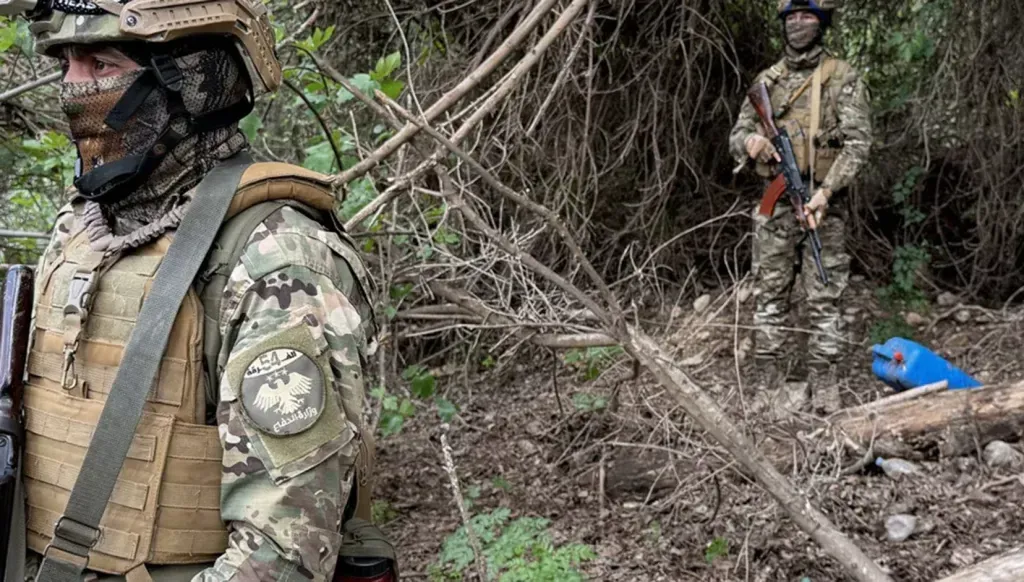


With continued uncertainty about the possibility of renewed war involving Iran and Lebanon, Damascus finds itself facing the consequences of a confrontation in which it is not directly involved, yet which lies along its political and security fault lines. The American push toward a more confrontational role with Hezbollah, Israeli pressure along the Syria and Lebanon fronts, and Turkish warnings of a subsequent Israeli escalation have placed the interim Syrian authority in a narrow space between security requirements, memories of war, and regional balance calculations.
Adding to the complexity of this situation is the fact that the regional actors involved in Syria do not interpret the war in the same way. Turkey, the main supporter of the Syrian authority, warns against the expansion of Israeli activity inside Syria, while other states do not wish for an Israeli victory that would consolidate its superiority. In this context, indications have begun to emerge of differing Syrian approaches toward Hezbollah’s weapons.
This divergence first appeared in the Syrian hesitation regarding the role expected from Damascus in Lebanon. Reuters revealed that Washington was pressing Damascus to intervene against Hezbollah. This was confirmed by Obayda Ghadban, the head of strategic studies at the Syrian Diplomatic Institute, in an interview on Syrian Al Ikhbariya television, where he stated that Damascus rejected the American request. Meanwhile, the US envoy Tom Barrack had denied that such an American request had been made in the first place.
What is Syria’s reading of the issue of strategic balance?
In the same interview, Obayda Ghadban made unusual remarks regarding the position on Israel’s war against Hezbollah. He was asked by the interviewer whether Syria, or “the strategists in the Ministry of Foreign Affairs,” believe that the continued existence of Hezbollah’s weapons reduces the Israeli threat. He replied that the region is experiencing a strategic imbalance, security vacuums, and actors seeking dominance, and that the dominance of any one side over another weakens Syria’s position. He added that maintaining this balance strengthens Syria and its relations, stressing that balance is what matters.
These remarks came after a series of statements by the Syrian Ministry of Interior announcing the arrest of cells it said were linked to Hezbollah, and affirming that the group’s activities threaten Syrian security, referring to cells, smuggling operations, and rockets. The most recent of these announcements concerned the Quneitra cell, which the authorities said was preparing to target the “neighbouring area” without naming Israel, and that it had been found in possession of rockets and concealed launch platforms prepared for use.
Border movements carrying indications
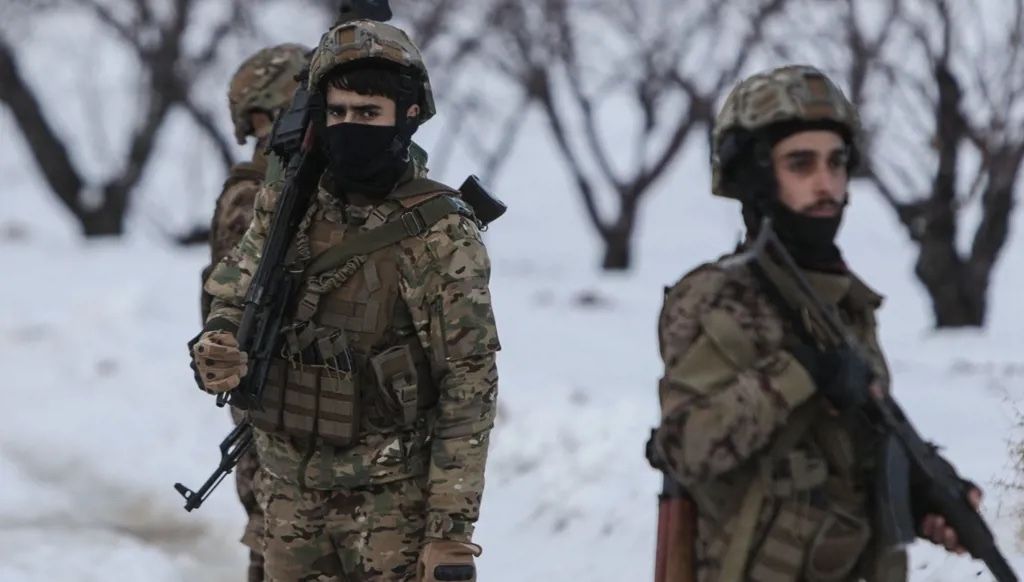
The Syrian–Lebanese border has witnessed over the past months sudden movements and the deployment of factions affiliated with the Syrian army without prior announcement. The situation peaked at the end of February, when Damascus confirmed the deployment, but its statements shifted between expressing readiness to help Lebanon in disarming Hezbollah and stressing that the goal was to control the border without any intention of intervention.
Ghadban’s statement gained its significance from its timing alongside discussions about a possible Syrian role in Lebanon, American pressure, Israeli escalation, and Turkish warnings. His background adds another layer; he was active in Turkey years before the fall of the former regime, and some Syrian circles describe him as ideologically close to the Muslim Brotherhood, while people close to him have repeatedly denied this.
This coincided with rising Turkish warnings about Israel. Turkish Foreign Minister Hakan Fidan warned that Israel’s preoccupation with its war against Iran does not mean it will not later move against Syria when conditions allow. These remarks came during a period that saw visits by Al-Sharaa and his foreign minister to Turkey and to Gulf countries, including Saudi Arabia, Qatar, and the United Arab Emirates.
Syria is bracing for the coming storm
A source close to the Political Affairs Department told Annahar that there are significant indications of the formation of a near-unified position among some influential regional states active in Syria, which do not want Hezbollah or Iran to be weakened in this war due to calculations related to regional security. The source considered that the Syrian position does not reflect genuine internal divergences as much as it represents an attempt to bend before the storm before it reaches Syria.
These calculations are not separate from broader regional movement regarding Hezbollah. A delegation from the group visited Turkey late last year, while Egyptian intelligence chief Major General Hassan Rashad visited Beirut, and informed circles spoke of contacts between him and Hezbollah.
Accordingly, the position on Hezbollah’s weapons goes beyond a border or security issue, revealing a governing structure still carrying remnants of the past factions and movements that helped shape it, operating within a network of divergent regional relationships that have remained present throughout the years of conflict with the former regime. Thus, this issue is not merely a border or security test, but rather a test of the Syrian authority’s ability to adopt a coherent political stance at a time when regional and international pressures exceed the capacity of official discourse to manage internal divergences within a single narrative.